

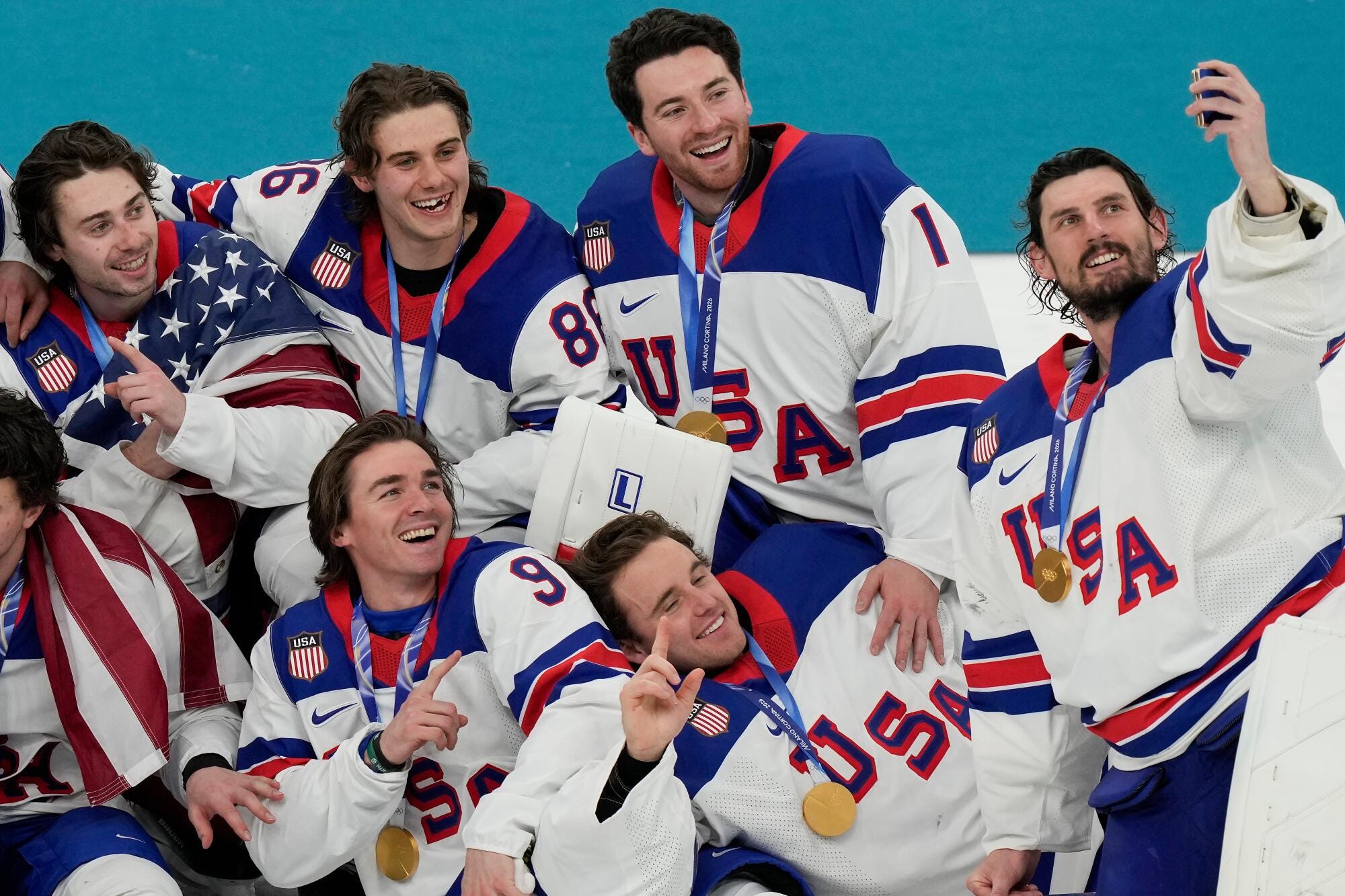
On February 22nd, the United States men’s hockey team won their first Olympic gold medal in 46 years. Jack Hughes in overtime. Connor Hellebuyck between the pipes. A team that played with joy, brotherhood, and — by all credible accounts — genuine affection for the women’s team that had won the same gold three days before them.
Then they went into the locker room.
And Bill Guerin, the team’s general manager, invited his friend Kash Patel in.
Not the players’ families. Not the coaching staff’s wives and children. Patel, Donald Trump’s FBI director, a man with no role in the team’s victory, was the only non-staff outsider in that room before anyone else was allowed in. He chugged a beer. He draped a gold medal he didn’t earn around his own neck. He pulled out his phone and called the president. And what followed — the joke about the women’s team, the laughter, the viral clip, the days of culture war fallout — flowed directly from that single decision made by the man at the top of the chain.
Here is the leadership lesson, and it starts not with the players, but with the executive.
In the latest episode of The Late Dialogues — a speculative podcast that brings historical thinkers back to life at the edges of the present — Later Abebe Bikila says something that has stayed with me since I heard it. Reflecting on his barefoot gold medal run through Rome in 1960, he describes the sequence with economy: ”I ran because my shoes didn’t fit. Then I won. Then it became symbol. These happened in order. Not the other way.”
That sequence — act, then meaning, then the weight of what the meaning becomes — is the condition of every Olympic athlete. You compete. You win. And then, almost immediately, the apparatus arrives to tell you what your winning meant, who it belonged to, what it was for. The athletes at Milan Cortina had no say in that process. They rarely do.
But the people around them did. And that’s where this story really lives.
A leader’s first obligation is not strategy, not vision, not winning. It is protection. Protection of the people in their charge, from avoidable harm, from preventable exposure, from being turned into instruments of someone else’s agenda.
Guerin failed that test in the most visible way possible.
He is a 54-year-old executive who has spent his life in professional hockey. He is the GM of the Minnesota Wild — Minnesota, no need to say more about the underlying meaning this carries. He is not a 24-year-old center surfing the adrenaline of the biggest game of his life. He knew, or should have known, exactly what it would mean to bring Kash Patel — not a hockey official, not a long-serving USA Hockey stakeholder, not a friend of the athletes — into that room as the first and only civilian guest, at that particular moment, on that particular stage.
Instead, he opened the door. For a friend. On the most watched night in American hockey in nearly half a century.
The apparatus was already rolling. Phones were out. Instagram Live was running. There was never going to be a private version of this. The locker room at the Olympic gold medal game is not a locker room anymore — it is a broadcast, a document, a permanent record. The Late Dialogues episode frames this condition precisely: athletes today compete in a world where ”every training session is filmed before the sweat dries, every emotion is monetized, every gesture demands to be seen.” If that is true on the ice, it is doubly true the moment the final horn sounds. Guerin, of all people in that room, should have understood that. His players, many of them barely in their mid-twenties, were drunk on joy and champagne. They needed someone to hold the line. He was the one positioned to hold it. He didn’t.
And then, when the fallout came, he said almost nothing. His only public statement, offered to The Athletic, was this: ”People react to everything nowadays... there was nothing that was set out to be political. There was nothing that was meant to harm anybody... we have unconditional love for our country.”
That’s not accountability. That’s a shrug dressed in a flag.
What makes his silence more striking is the contrast with some of his own players. Jeremy Swayman looked reporters in the eye and said: “We should have reacted differently.” Full stop. Charlie McAvoy apologized directly: “Certainly sorry for how we responded to it in that moment... it’s certainly not reflective of how we feel about them.” Auston Matthews, the team’s captain, called it “unfortunate” and reaffirmed the team’s love for the women’s program. These are young men, processing a complex moment in real time, under enormous public scrutiny, showing more clarity and more courage than the executive whose personal decision created the situation they were left to clean up.
That inversion is worth sitting with.
Bikila again, in the episode: ”Your body isn’t only yours. But it’s yours enough. What you do with it — that’s the space you have. Smaller than you want. Larger than nothing.” That’s the condition of the athlete. But it maps, uncomfortably well, onto the condition of those players in the days after the locker room. The space they had was small — a press conference question, a few sentences into a microphone. Some of them used it honestly. The man who had the larger space, the executive space, the space that could have prevented the whole thing, used his to say as little as possible.
Leadership is not the title on the organizational chart. Leadership is who steps forward when things go wrong, who absorbs the heat so others don’t have to, who says “that’s on me” before being asked. Several players in their twenties did exactly that. The seasoned executive who made the call that started everything offered a one-liner about loving his country and moved on.
Hilary Knight, the women’s team captain, closed this story better than anyone else in it. She didn’t perform outrage. She didn’t deflect. She said: ”Women aren’t less than, and our achievements shouldn’t be overshadowed by anything else other than how great they are.” She turned a moment of being diminished into a teaching. That is what real authority looks like — not the kind conferred by a title, but the kind earned in how you carry yourself when someone else’s decision drops a mess at your feet.
The Late Dialogues asks, at the heart of this episode, what remains when the apparatus falls away — when the medals are counted, the cameras pack up, and you’re left with just the person you were in the moment. For some of these athletes, what remains is integrity. For the man who held the door open that night, what remains is a question he has yet to answer.
The gold medals are real. The achievement is extraordinary. And the lesson is real too.
In a world where no stage goes dark — where the locker room is always already a broadcast, where the celebration is always already content — the most important decision a leader makes is often not the strategic one. It’s the guest list. It’s who you let in the room. It’s whether you remember, in the flash of the moment, that you are not just serving your own joy or your own friendships. You are holding something that belongs to other people.
Bill Guerin forgot that. Some of his players, to their credit, remembered it, even after the fact, even under pressure, even when no one was requiring them to.
That’s the difference between a title and a leader.
If this resonates, the latest episode of The Late Dialogues — “What the Body Knows” — is a good place to sit with the deeper question underneath the spectacle.
Great piece. I did not know this background.