

“We’re riddled with pointless talk, insane quantities of words and images. Stupidity’s never blind or mute. So it’s not a problem of getting people to express themselves but of providing little gaps of solitude and silence in which they might eventually find something to say. Repressive forces don’t stop people expressing themselves but rather force them to express themselves; what a relief to have nothing to say, the right to say nothing, because only then is there a chance of framing the rare, and even rarer, thing that might be worth saying.” — Gilles Deleuze, Negotiations
I used that quote to open this Substack. I’m returning to it now, because something has shifted — and Deleuze, as usual, was ahead of it.
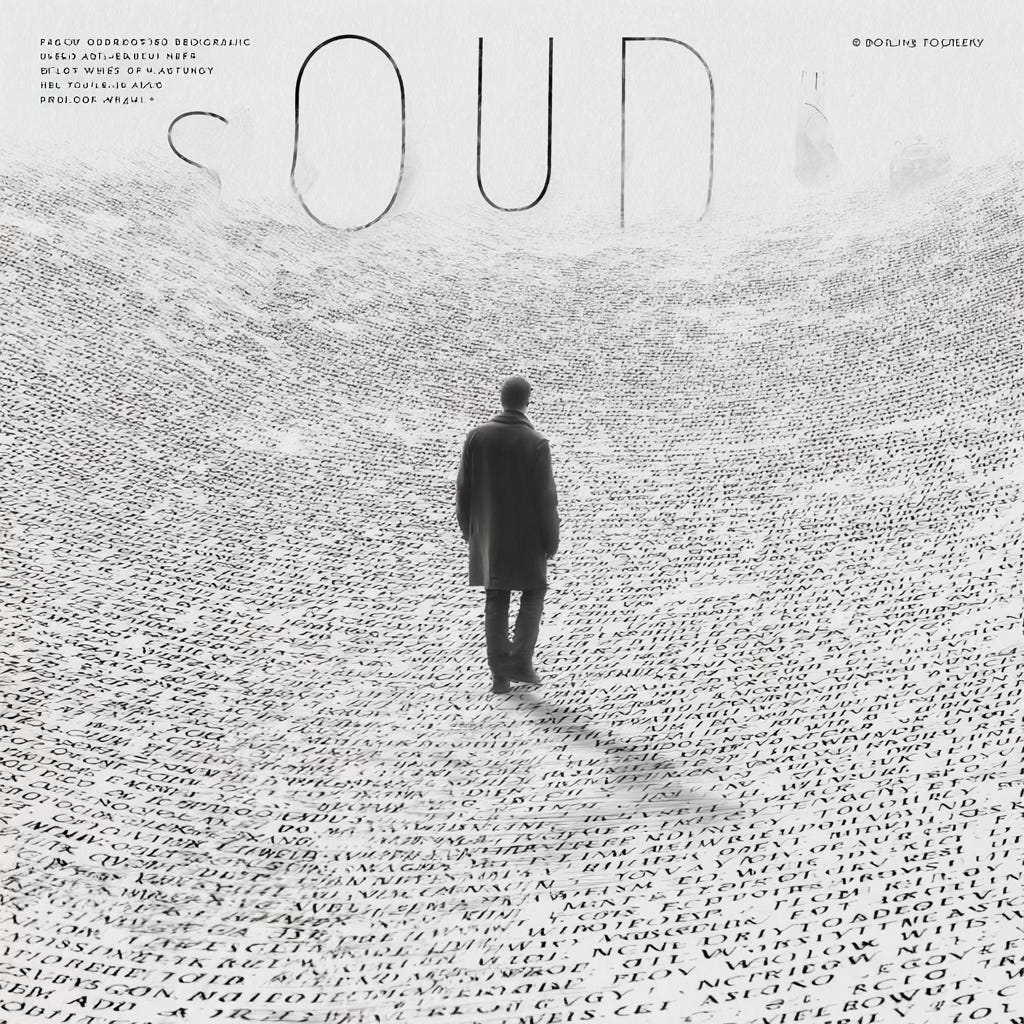
Writing is demonetized.
Not worthless. Demonetized. There’s a difference, and it matters.
Not long ago, if you could write — clearly, compellingly, beautifully when luck aligned — you had an edge. In the heyday of print, yes. But also at the height of blogging, of Twitter’s early intellectual energy, of long-form publishing’s brief digital renaissance. The ability to put thought into well-crafted sentences was a form of leverage. It opened doors, built audiences, earned trust. Words, wielded well, were currency.
AI didn’t steal that. It inflated it out of existence.
What I read on LinkedIn today, in opinion pieces, on Substack from voices I don’t recognize, is often technically sound and sometimes even stylistically coherent — especially when people or brands have spent real time training their agents on their tone, their references, their way of seeing. Just as I’ve done here, with Talking Too Many, over years of conversation and iteration with Claude.
But it doesn’t matter anymore. Not the way it did.
The scarcity didn’t disappear — it migrated. Upstream.
Writing was never the one rare thing. Something worth saying was. Wordcraft was the camouflage. A good sentence could dress up a thin thought and make it look like wisdom. AI just pulled the curtain back. Now the thin thoughts are everywhere, dressed beautifully, indistinguishable from one another — technically polished, emotionally vacant, algorithmically confident.
Deleuze wasn’t diagnosing a future crisis when he wrote those lines. He was describing a condition that had already arrived. Repressive forces — commercial, social, algorithmic — don’t silence us. They do something worse: they compel us to speak. Constantly. Without pause. Without the solitude that makes speech worth hearing. AI has simply become the most efficient engine yet for that compulsion.
So what remains scarce? What still has value in a world where words are free?
A position. A lived stance. The willingness to be wrong in public, to have changed your mind and say so, to see something others aren’t seeing yet — or to name what everyone is sensing but no one has said.
In that loud void, new voices resonate — in politics, in culture, in corporate America. Graham Platner and Chris Talarico with plainspoken moral clarity. Ricky Ubeda and Damien Jalet, setting bodies in motion in ways no prompt will ever generate.
There’s a status I’ve used on WhatsApp for years: “what say you.” Three words, no question mark. An invitation that assumes you have something to offer — not just something to say, but a you doing the saying.
That’s the edge now. Not the sentence. The you behind it.
Opinion plus AI words won’t emerge from the noise. Staked honestly, with the courage to hold it and the willingness to have it tested — that will. Not always loudly. Maybe, as Deleuze would have it, quietly. In the gaps. In the rare and rarer thing.
This is what the Human-AI Interface asks of us, in the end. As execution gets delegated — to models, to agents, to workflows we barely supervise — the quality of human intention becomes the only thing that counts. And intention isn’t a prompt. It’s a practice. It requires silence. It requires, sometimes, the right to say nothing at all.
The question isn’t whether you can write anymore. What say you?
PS: the irony of this AI-written post is not lost on me, it is actually found exactly where it belongs, at the intersection of my thoughts, and your attention.